August 31, 2026 · Belief
SOULISM • PHILOSOPHY
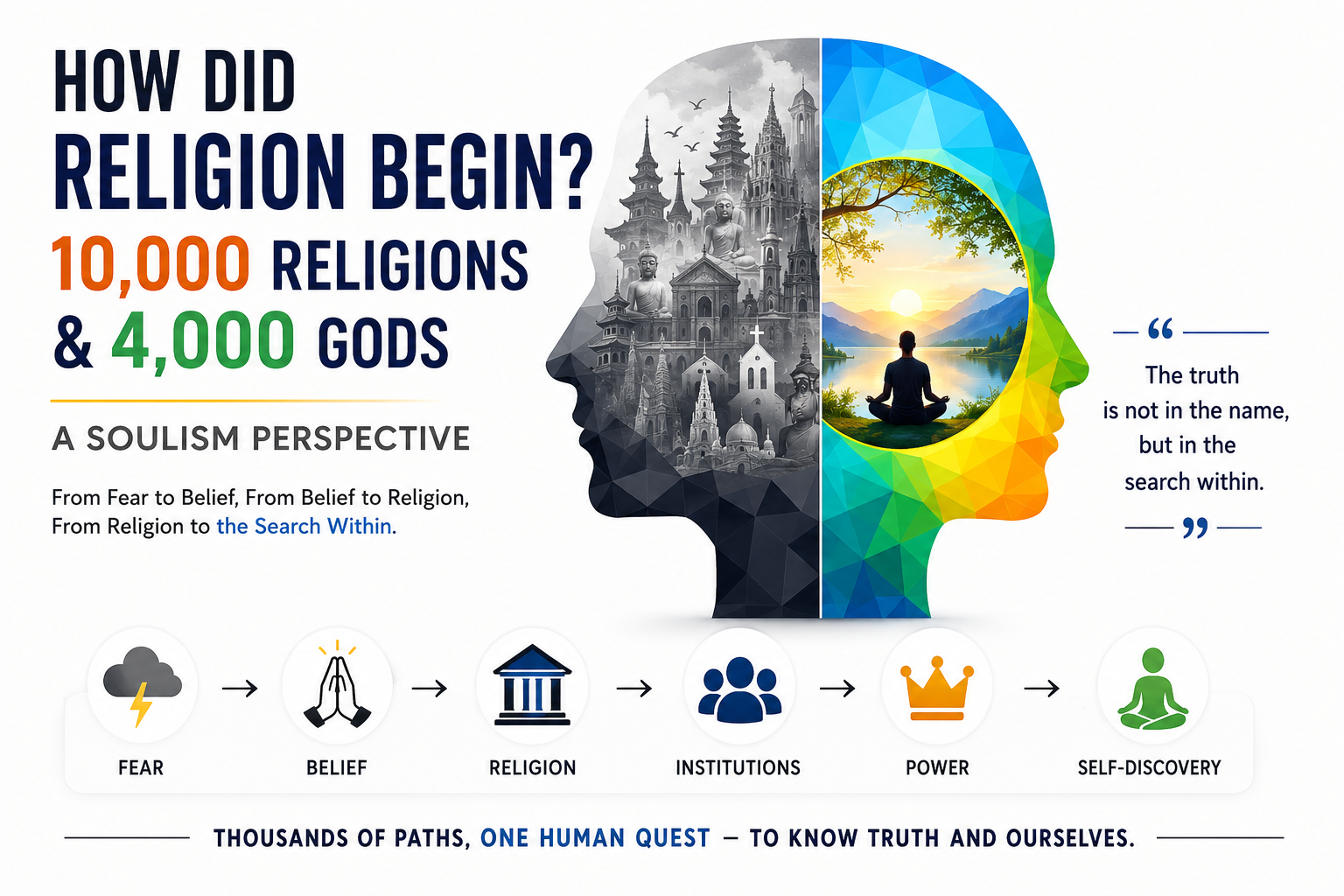
How Did Religion Begin? How Did 10,000 Religions and 4,000 Gods Come to Exist?
From Fear to Belief, From Belief to Religion, and From Religion to the Search Within — A Soulism Perspective
How did religion begin?
How did thousands of religions emerge?
How did humanity come to imagine thousands of different gods?
These questions may sound simple. But when we look deeper, we are not only studying the history of religion. We are looking at the history of humanity itself—our fear, curiosity, imagination, uncertainty, search for security, desire for meaning, and sometimes our desire for power.
Religion did not simply appear one morning out of nowhere.
Human beings lived for thousands of years without modern science, medicine, technology, or reliable explanations for many natural events. They faced forces much greater than themselves.
Lightning struck. Storms arrived. Floods destroyed homes. Droughts destroyed crops. Disease appeared without warning. Loved ones died. Night brought darkness and uncertainty.
And death remained one of the greatest mysteries of all.
Human beings needed explanations.
And when an explanation was unavailable, imagination often filled the gap.
That may have been one of the earliest steps in humanity's long journey from fear to belief, belief to religion, and religion toward the search for meaning.
From Fear to Gods
The greatest fear of early humanity was not simply darkness. It was the unknown.
People did not know why lightning struck. They did not understand storms. They could not explain disease. They did not understand what happened after death.
Yet the human mind does not easily tolerate unanswered questions.
When people cannot explain something, they often create an explanation.
And when something appears powerful, unpredictable, and beyond human control, people may begin to imagine that it possesses intention or consciousness.
A storm was no longer simply a storm. It could become the anger of a supernatural being.
The sun was no longer simply a star. It could become a divine power.
The river was not simply water. It could become a sacred force.
The ocean could become a god.
In this way, early religious behavior can be understood partly through humanity's attempt to cope with uncertainty, danger, death, and the mysteries of nature.
But fear was not the only force involved.
Human beings also experienced wonder, gratitude, love, awe, curiosity, and deep reflection about existence.
Religion was therefore likely shaped by many human experiences rather than by one single cause.
When Fear Became Tradition
Imagine an ancient community that experiences something unusual near a particular tree.
Perhaps someone survived a dangerous illness after spending time there. The community begins to consider the tree special.
Parents tell their children: “This tree is sacred.”
Those children tell their children. Generation after generation repeats the story.
Eventually, people may remember the tradition but forget how it began.
When the original reason for a belief is forgotten, the belief itself can begin to look like an unquestionable truth.
How Did Thousands of Gods Appear?
If humanity imagined gods, why were there so many?
Ancient human societies were separated by enormous distances. Different communities lived in different environments, faced different dangers, depended on different resources, and developed different languages and cultures.
For a farming society, rain could be a matter of survival. For a coastal society, the ocean could represent both life and destruction.
For mountain communities, mountains could appear mysterious and powerful. For other societies, fertility, harvest, death, healing, wisdom, or war could become central religious themes.
Human beings often gave meaning and personality to the forces surrounding them.
This helps explain why different civilizations developed very different religious systems.
The exact number of historical gods and religions is difficult to establish because definitions and historical records vary widely.
Therefore, numbers such as “4,000 gods” or “10,000 religions” should be treated cautiously—not as universally accepted precise historical counts, but as expressions of the enormous diversity of human religious traditions.
When Fear Became Power
The story becomes more complicated when religious belief becomes connected with social authority.
Imagine someone claiming: “I know how to communicate with this invisible power.”
Such a person could gain influence within a community.
This does not mean every priest, spiritual teacher, or religious leader throughout history was manipulating people. Many served important roles as teachers, scholars, counselors, and community leaders.
But religion and political or social power have also been closely connected in many societies throughout history.
Where fear exists, the possibility of control also exists.
Religious belief can provide meaning and comfort. But whenever fear becomes a tool for unquestioned obedience, it deserves careful examination.
Heaven, Hell, and the Human Need for Certainty
One of humanity's deepest uncertainties is death.
What happens after we die?
Different cultures developed different answers: heaven, hell, rebirth, liberation, paradise, spiritual transformation, or complete dissolution.
These ideas cannot simply be reduced to fear. They can also express hope, morality, philosophical reflection, and the human desire to understand existence.
But there is an important distinction between believing an answer and knowing an answer.
Are we seeking truth—or are we seeking certainty?
How Did Thousands of Religions Develop?
Religious traditions did not remain static. They evolved, were interpreted, divided, merged, and adapted to different cultures and historical circumstances.
A useful way to understand this process is:
Experience
→
Interpretation
→
Teaching
→
Tradition
→
Institution
→
Identity
Once identity becomes involved, something else can happen:
“My path is correct” can become “Everyone else's path is wrong.”
Religion and Spirituality Are Not the Same Thing
Religion and spirituality can overlap, but they are not necessarily identical.
Religion may involve institutions, scriptures, rituals, traditions, communities, identity, and established practices.
Spirituality can be more personal. It may involve self-reflection, awareness, meditation, contemplation, compassion, and questions about existence.
The important question is not simply what someone believes, but what that belief produces within them.
- Does it create greater awareness?
- Does it encourage compassion?
- Does it encourage honesty?
- Does it encourage the search for truth?
- Does it reduce unnecessary fear?
Soulism: Beyond Religious Identity
Soulism is a philosophical framework centered on conscious awareness, personal responsibility, reason, compassion, and inner exploration.
Soulism does not require a person to immediately abandon existing beliefs. Instead, it encourages deeper questions.
Not only: “Which religion am I?”
But: “Who am I?”
Not only: “What should I believe?”
But: “How do I know?”
The purpose is not to replace one unquestioned belief with another. The purpose is to encourage conscious inquiry.
One Truth, Thousands of Expressions
If there are thousands of religions, does that mean there are thousands of different truths?
Not necessarily.
There is an important difference between truth and the way humans describe or interpret truth.
Different cultures can give different names to the same sky. The sky does not change because the language changes.
Similarly, humanity may have expressed its deepest questions through thousands of different languages, symbols, stories, and philosophies.
The words may be different. The symbols may be different. The stories may be different.
But the fundamental questions can be remarkably similar:
- Who are we?
- Why are we here?
- Why do we suffer?
- What is consciousness?
- What happens when we die?
- What is truth?
- How should we live?
Did Humans Create God?
This is one of the most controversial questions in philosophy.
Human cultures have clearly created enormously diverse concepts and images of gods. History, anthropology, psychology, and sociology can help us study how human beings developed and transformed these ideas.
However, the existence of diverse human concepts of gods does not scientifically prove that no ultimate reality or divine existence exists.
These are two different questions:
How did humans develop concepts of gods?
Does an ultimate divine reality actually exist?
Does an ultimate divine reality actually exist?
A responsible philosophy should be willing to acknowledge uncertainty.
“We do not know everything.”
Is Truth Outside Us or Within Us?
If there are thousands of religions, thousands of gods, and thousands of interpretations, where should a person look?
Perhaps we should pause.
Look inward.
Observe the mind. Observe fear. Observe desire. Observe anger. Observe attachment. Observe ego. Observe beliefs. Observe consciousness itself.
Then ask:
Who am I?
Someone can guide you. Someone can teach you. Someone can give you a question. But the journey of self-understanding must ultimately be yours.
From Religion to Inner Discovery
Soulism asks humanity to examine the role religion plays in human life.
Does belief make us more conscious? Does it make us more compassionate? Does it make us more honest? Does it encourage us to seek truth?
These questions can be asked by believers, non-believers, and everyone in between.
Soulism therefore shifts the focus from external identity toward conscious awareness.
Thousands of Branches, One Human Root
Think about a tree.
It can have thousands of branches and millions of leaves, but beneath all of them is a root system.
Human spirituality may be similar.
The expressions can be countless. The languages can be different. The symbols can be different. The stories can be different.
But behind many of them is the human desire to understand existence.
Perhaps the real tragedy is not that humanity has thousands of religions. Perhaps it is that we sometimes become so busy defending our branches that we forget to look for the roots.
Soulism Is Not About Replacing One Religion With Another
If Soulism simply asked people to abandon one religion and immediately accept Soulism as another absolute belief system, it would repeat the same pattern.
The goal is different.
- Awareness
- Reason
- Compassion
- Personal responsibility
- Freedom from unnecessary fear
- Respect for nature
- Honest inquiry
The Final Question
So, how did religion begin?
Perhaps there was no single beginning.
Fear played a role. The unknown played a role. Wonder played a role. Death played a role. Nature played a role. Human imagination played a role. The search for meaning played a role.
And throughout history, institutions and power also became connected with religion in many societies.
How did thousands of religions develop?
Through thousands of cultures, experiences, interpretations, historical circumstances, institutions, languages, and traditions.
How did thousands of gods emerge?
Through humanity's diverse attempts to understand nature, life, death, consciousness, and existence.
But behind all of those gods, religions, rituals, philosophies, and stories was something remarkably consistent:
The human being asking questions.
From Thousands of Gods to One Question
Perhaps we have spent thousands of years asking:
“Which God is the right one?”
Maybe another question deserves equal attention:
“What is truth?”
And beyond that:
“Who am I?”
You can find thousands of temples, churches, mosques, scriptures, teachers, traditions, and beliefs.
But no one can walk your inner journey for you.
Someone can point toward a path. Someone can give you wisdom. Someone can challenge your assumptions.
But ultimately, you must observe, think, question, and experience for yourself.
That is where Soulism begins.